Why Professional Bakers Use Grams Instead of Cups
Open up any cookbook by a serious pastry chef or bread baker, and you'll notice something immediately: there isn't a "cup" or "teaspoon" in sight. Instead, you'll see lists of exact numbers ending in a simple "g" for grams.
This isn't chefs trying to sound fancy or make baking harder than it needs to be. It's because weighing ingredients is the only way to guarantee your recipes turn out right every single time. Here is why pros live and die by the kitchen scale, and why you should dump your cups too.
Why Grams Beat Cups Every Time
- ›Perfect Consistency: Grams measure actual weight. A gram of flour is always a gram, whether it's humid outside, or your flour is packed tight in the bag.
- ›No More Fraction Math: Grams use easy whole numbers. Try multiplying 2 1/4 cups by 1.5, and you'll see why whole numbers are a lifesaver.
- ›Chef-Level Scaling: It makes scaling recipes up or down incredibly simple, and lets you troubleshoot baking mistakes before they even go in the oven.
Ready to Bake Like a Pro?
Take the guesswork out of your baking. Use our free Cups to Grams Converter to translate cup measurements into precise grams.
The Nightmare of Fraction Math
Have you ever tried to halve or double a recipe that uses cups? The math gets messy fast. If a recipe calls for 2/3 cup of flour and you want to make a quarter batch, you need 1/6 of a cup. Good luck finding a 1/6 measuring cup in your kitchen drawer.
With grams, it's just simple math. That 2/3 cup of flour weighs about 80 grams.
80g ÷ 4 = 20g.
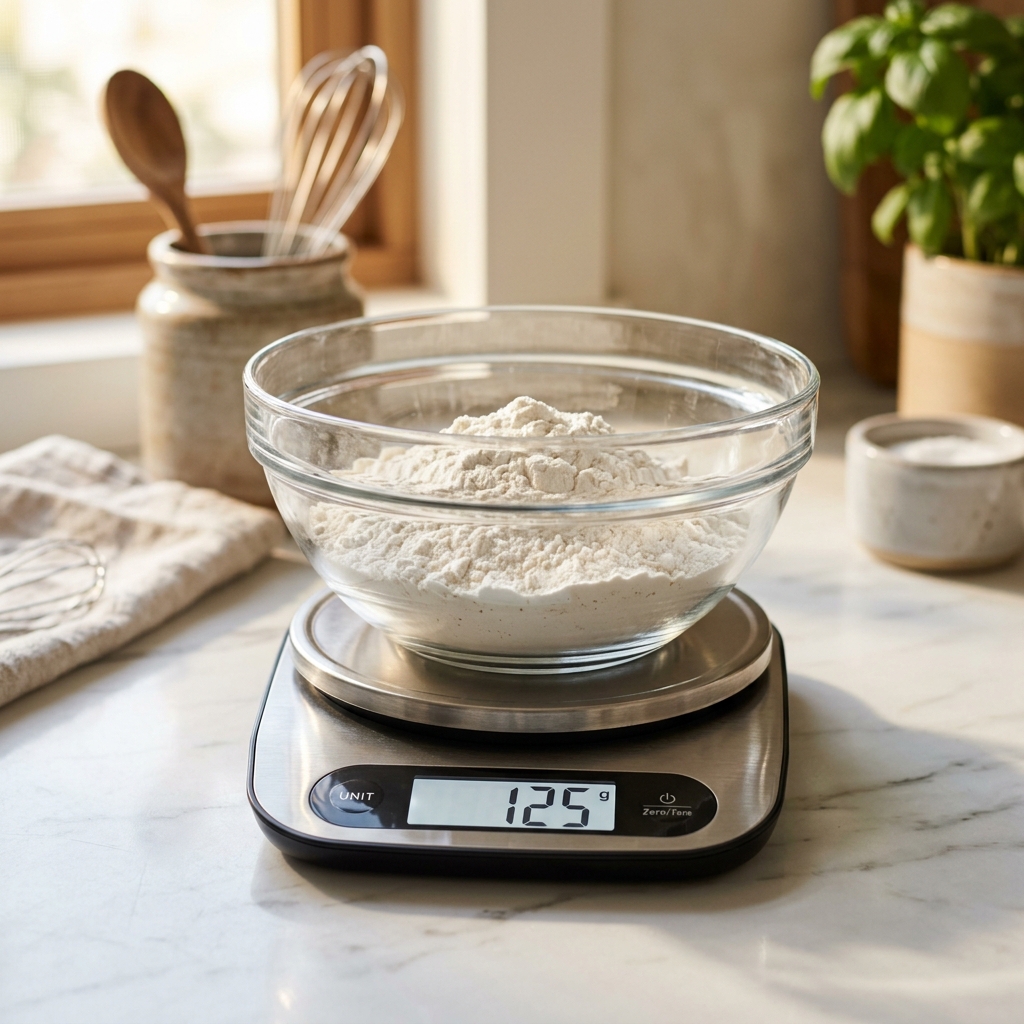
You just set your bowl on the scale, hit tare, and pour in 20 grams. No math headaches, no dirtying five different cups, and zero guesswork.
| Ingredient | Cups | Grams | Half (Cups) | Half (Grams) |
|---|---|---|---|---|
| All-Purpose Flour | 2 1/4 cups | 270g | 1 cup + 2 tbsp | 135g |
| Granulated Sugar | 3/4 cup | 150g | 6 tbsp | 75g |
| Unsalted Butter | 1/2 cup | 113g | 1/4 cup | 57g |
| Cocoa Powder | 2/3 cup | 60g | 5 tbsp + 1 tsp | 30g |
Baker's Percentages: The Secret Chef Code
In professional bakeries, recipes aren't just lists of ingredients—they are formulas. Bakers set the total weight of the flour to 100%, and then calculate every other ingredient as a percentage of that weight.
For example, a classic sourdough formula looks like this:
- Flour: 100% (e.g., 1000g)
- Water (Hydration): 70% (700g)
- Sourdough Starter: 20% (200g)
- Salt: 2% (20g)
Looking at a recipe this way tells you exactly what kind of dough you're dealing with before you even touch it. You can instantly see if it will be a wet, sticky dough (70% hydration is relatively high) or a stiff one. Even better, you can scale this to make one loaf or a hundred loaves just by changing the flour weight. Try doing that with cups, and you'll lose your mind.
Kitchen Reference
Try Our Recipe Scaler
Ready to scale your recipe without the headache?
Our free Recipe Scaler Tool does the heavy lifting for you. It multiplies or divides your ingredient weights instantly, keeping your hydration and ratios perfectly in line.
More Handy Baker's Tools
Keep your kitchen measurements accurate with these free calculators:
- Cups to Grams Converter — Swap volume cups to weight measurements.
- Recipe Scaler — Easily scale your recipes up or down.
- Unit Converter — Quickly switch between metric and imperial.
- Grams to Cups Converter — Convert weights back to cups.
Wrapping Up
Switching to grams isn't about being fussy—it's about making sure your hard work in the kitchen actually pays off. By using a cheap digital scale and measuring in grams, you'll save yourself from dry cakes, dense bread, and a sink full of dirty measuring cups. Trust me, once you make the switch, you'll never go back.
Frequently Asked Questions
Recommended Reading
Why Professional Bakers Weigh Ingredients Instead of Using Measuring Cups
Why do professional bakers refuse to use measuring cups? Because a cup of flour can weigh anywhere from 120g to 165g. Here is why grams will change your baking forever.
Cups vs. Grams: Why Baking by Weight Actually Works
Ever wonder why your chocolate chip cookies turn out different every time you bake them? Let's talk about why swapping your measuring cups for a digital scale is the easiest upgrade you can make.
Why One Cup of Flour Doesn't Always Weigh the Same
Why does a cup of flour weigh different amounts every time you measure it? Learn how settling, humidity, and technique mess with your recipes.