How to Scale a Recipe Up or Down Without Ruining It
We've all been there: you find a great cookie recipe that makes 24 cookies, but you only need 12. You cut all the ingredients in half, but the cookies turn out flat or dry. Or you double a cake recipe and end up with a dense, gummy mess.
Your math wasn't wrong. The problem is that some ingredients don't follow the rules of simple multiplication. Scaling down or up sounds like easy division, but there are a few tricky exceptions that most cookbooks never tell you about. Here is what you need to know.
The Quick Rules of Scaling
- ›Scaling Factor: The multiplier: Divide the number of servings you want by the original servings to get your scaling factor.
- ›Linear Scaling: Main ingredients scale normally: Flour, sugar, butter, and liquids multiply in a straight line.
- ›Leavening Adjustment: Ease up on leaveners: If you're doubling or tripling a bake, cut back on yeast, baking powder, or baking soda by 10% to 25% so the batch doesn't rise too fast and collapse.
- ›Spices & Salt: Go easy on salt and spices: Don't just multiply these. Strong flavors concentrate in big batches, so start with 1.5x and taste as you go.
- ›Pan Sizing: Watch the pan depth: Keep your batter or dough at the same depth as the original to keep baking times predictable.
Let Us Do the Math
Scale any recipe to fit your table. Our free Recipe Scaler Tool does the math and automatically adjusts the tricky leaveners and spices for you.

Step 1: Find Your Magic Multiplier
To get started, divide the servings you want by what the recipe originally makes. This gives you your scaling factor:
Scaling factor = servings you want ÷ original servings
Examples:
- Original: 12 cookies → desired: 24 cookies → factor = 2×
- Original: 8 servings → desired: 4 servings → factor = 0.5×
- Original: 6 servings → desired: 10 servings → factor = 1.67×
Multiply every ingredient amount by that factor. For most ingredients, that's all you need to do.
Step 2: What Multiplies Normally (and What Doesn't)
Most ingredients are easy. You just multiply them by your scaling factor and you're good to go. Scale these in a straight line:
- Flour, sugar, cornstarch — all structural dry ingredients
- Butter, oil, shortening — fats scale cleanly
- Milk, cream, water, broth — all liquids
- Eggs (beat and weigh to split eggs)
- Vanilla extract, citrus zest — at normal scaling factors
Watch out for these exceptions:
Baking Powder, Baking Soda, and Yeast
This is where most scaled recipes fail. If you use too much baking powder or baking soda, your cakes will shoot up in the oven, collapse in the center, and taste metallic or soapy. Too little, and you'll end up with a brick.
Here is the rule of thumb: if you are doubling a recipe, use about 1.75 times the baking powder or soda instead of doubling it. If you're tripling or quadrupling, keep it to 2.25 or 2.5 times the original amount. As a chef's tip, try not to exceed 1 to 1.25 teaspoons of baking powder per cup of flour, no matter how big the batch is.
When scaling a recipe down, leavening is much more forgiving. Simply halving or dividing normally works just fine.
Salt and Strong Spices
Flavor profiles change in large batches. If a soup needs 1 teaspoon of salt for 4 servings, multiplying it to 4 teaspoons for 16 servings will make it inedible. It will likely only need 2.5 to 3 teaspoons. Trust me, it's always best to season gradually and taste as you go rather than relying on strict math.
For baking—where you can't taste the batter once it's in the oven—scale the salt to about 75% of the multiplied amount if you are tripling the recipe. It is always safer to err on the side of less.
How to Handle Eggs
Eggs scale in a straight line, but you can't crack open half an egg. If a 1.5x batch calls for 4.5 eggs, here is how to handle it: Whisk two eggs together, weigh the mixture (a standard large egg is about 50 grams without the shell), and pour in 25 grams. If you don't have a scale, you can round up to 5 eggs and cut back on a tablespoon of milk or water elsewhere, or just round down to 4 if you're making something simple like pancakes.
Step 3: Convert to Weights First
This is the secret to making scaling completely headache-free.
Scaling by cups multiplies the error in every scoop. If your '1 cup' of flour is actually 130 grams instead of the standard 120 grams, tripling the recipe means you're off by 30 grams before you even start mixing. If you scale it four times, that error gets huge.
The fix is simple: convert everything to grams first, then multiply. Use our cups to grams converter, write down the weights, and multiply those. Weights are clean, precise, and scale beautifully without the math headache of fractions of cups.
Step 4: Watch the Pan Size and Bake Time
This is where many home cooks get tripped up, even when their ingredient math is perfect.
The depth rule: When you double a recipe, you need a bigger pan. But you want the batter or dough to sit at the same depth as the original recipe. Batter thickness dictates how heat travels. If you pour a double batch of brownies into the original pan, they'll be twice as deep. The edges will burn before the middle even begins to set.
Here are some quick pan swaps to keep your depth consistent:
| If original calls for | For 2× batch use |
|---|---|
| 8×8 inch square | 9×13 inch |
| 9-inch round cake pan | Two 9-inch pans |
| 9×5 inch loaf pan | Two standard loaf pans |
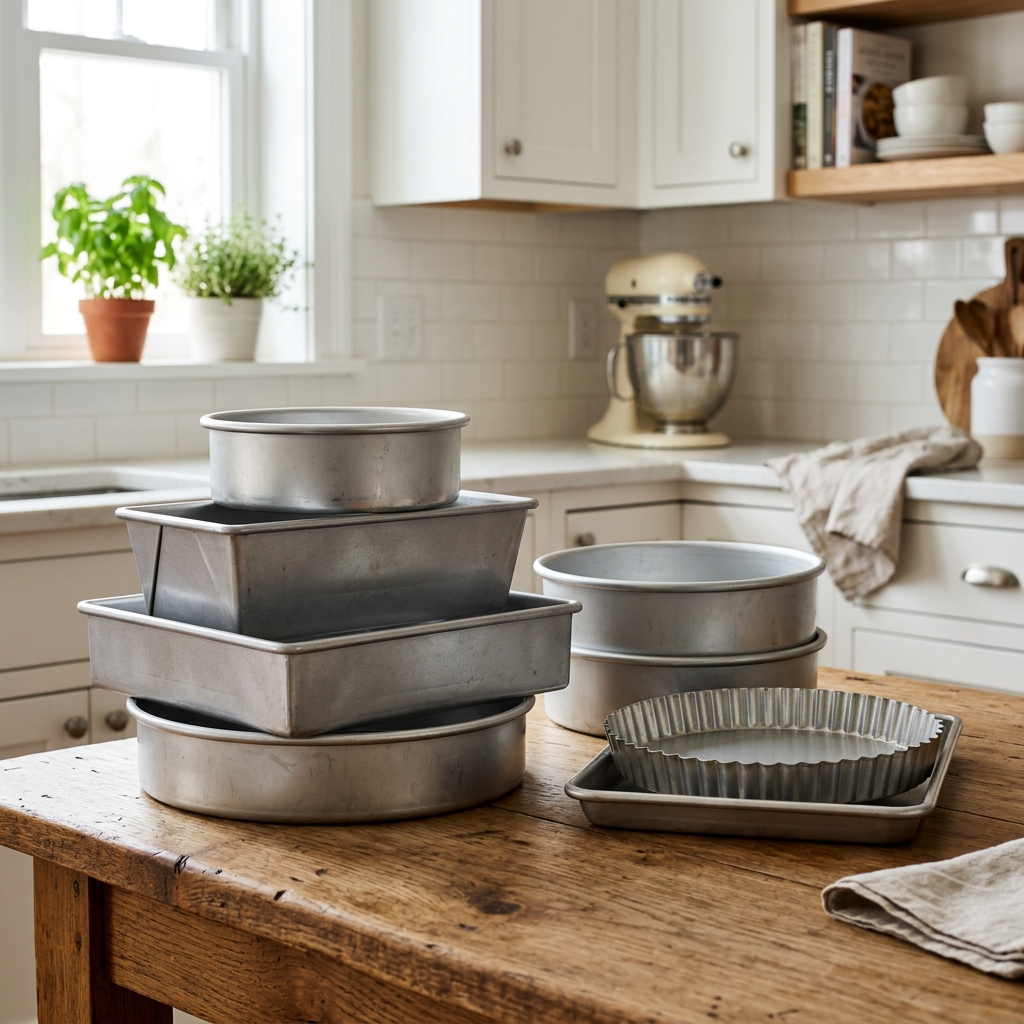
Baking time: If you use a larger pan and keep the depth of the batter the same, the bake time will stay roughly the same. If you scale down and the batter is thinner, start checking 10 to 15 minutes early. The only way to know for sure is to use a toothpick or a digital thermometer—never just trust the clock.
If you are scaling up a lot and baking in one giant pan rather than splitting it into two standard pans, drop the oven temperature by 25°F (15°C) and bake it longer. This gives the center time to cook through without burning the edges.
Step 5: How to Translate Awkward Fractions
If you multiply 1/3 cup by 2.5, you get 5/6 cup—which doesn't exist in any kitchen drawer. Here is how to measure out these awkward results using standard cups and spoons:
| Volume | Equivalent |
|---|---|
| ¾ cup | ½ cup + 2 tablespoons + 2 teaspoons |
| ⅔ cup | ½ cup + 2 tablespoons + 2 teaspoons (close enough) |
| ⅓ cup | 5 tablespoons + 1 teaspoon |
| ⅙ cup | 2 tablespoons + 2 teaspoons |
Or better yet, convert the recipe to grams and skip this headache completely.
Convert to grams first, then scale. Measuring by cups doubles down on the inaccuracies of volume. Switching to weights makes the math clean and easy.
Which Recipes Forgive (and Which Don't)
Very forgiving: Soups, stews, quick breads, muffins, cookies, pancakes, and pasta. A small scaling error here and there won't ruin your dinner.
Not forgiving at all: Soufflés, macarons, choux pastry, yeast breads, croissants, and custards. These depend on exact chemistry. A 10% error in your flour or baking powder can lead to a flat bake.
For easy recipes, rough scaling is perfectly fine. But for precise baking, weigh everything in grams, ease up on the leaveners, and maybe test a half-batch before you cook for a crowd.
Chef's Example: Scaling Chocolate Chip Cookies
Original Recipe (makes 24 cookies):
- 2¼ cups (270g) all-purpose flour
- 1 tsp baking soda
- 1 tsp salt
- 1 cup (2 sticks / 227g) butter
- ¾ cup (150g) granulated sugar
- ¾ cup (165g) brown sugar, packed
- 2 large eggs
- 2 tsp vanilla extract
- 2 cups chocolate chips
Doubled Recipe (makes 48 cookies):
| Ingredient | Original | 2× Linear | Adjusted |
|---|---|---|---|
| Flour | 270g | 540g | 540g |
| Baking soda | 1 tsp | 2 tsp | 1¾ tsp |
| Salt | 1 tsp | 2 tsp | 1¾ tsp |
| Butter | 227g | 454g | 454g |
| Granulated sugar | 150g | 300g | 300g |
| Brown sugar | 165g | 330g | 330g |
| Eggs | 2 | 4 | 4 |
| Vanilla | 2 tsp | 4 tsp | 4 tsp |
| Chocolate chips | 2 cups | 4 cups | 4 cups |
Let Us Do the Math
Ready to get baking? Skip the paper calculations, awkward egg conversions, and pan size math.
Our Recipe Scaler Tool takes care of the numbers. Just type in your ingredients, set it to 0.5x, and get precise weights ready for your scale.
Related Measurement Tools
Keep your kitchen conversions simple with these free tools:
- Recipe Scaler — Scale recipe servings up or down.
- Servings Calculator — Adjust ingredient quantities based on portion counts.
- Baking Pan Size Converter — Compare areas and scale recipes between pans.
- Unit Converter — Switch between metric and imperial measurements.
Wrap Up
If you're doubling cookies, bake them on two separate sheet pans in rotation rather than crowding them onto one. The bake time stays the same since the individual cookies are still the same size. Weigh your ingredients, keep an eye on your leaveners, and you'll get perfect results every time.
Frequently Asked Questions
Recommended Reading
How to Double a Recipe Without Ruining the Bake
Scaling up a recipe isn't just about multiplying every ingredient by two. Here is what actually works for leaveners, spices, and baking times so your double batch turns out great.
How to Halve a Recipe Without Mistakes
Need to cut a recipe in half? Here is how to do the math, split an egg, pick the right pan, and adjust your baking time without ruining your dinner.
How to Triple a Recipe Without Ruining It
Making a massive batch? Here is why you can't just multiply every ingredient by three, how to adjust leavening, and how to scale spices safely.