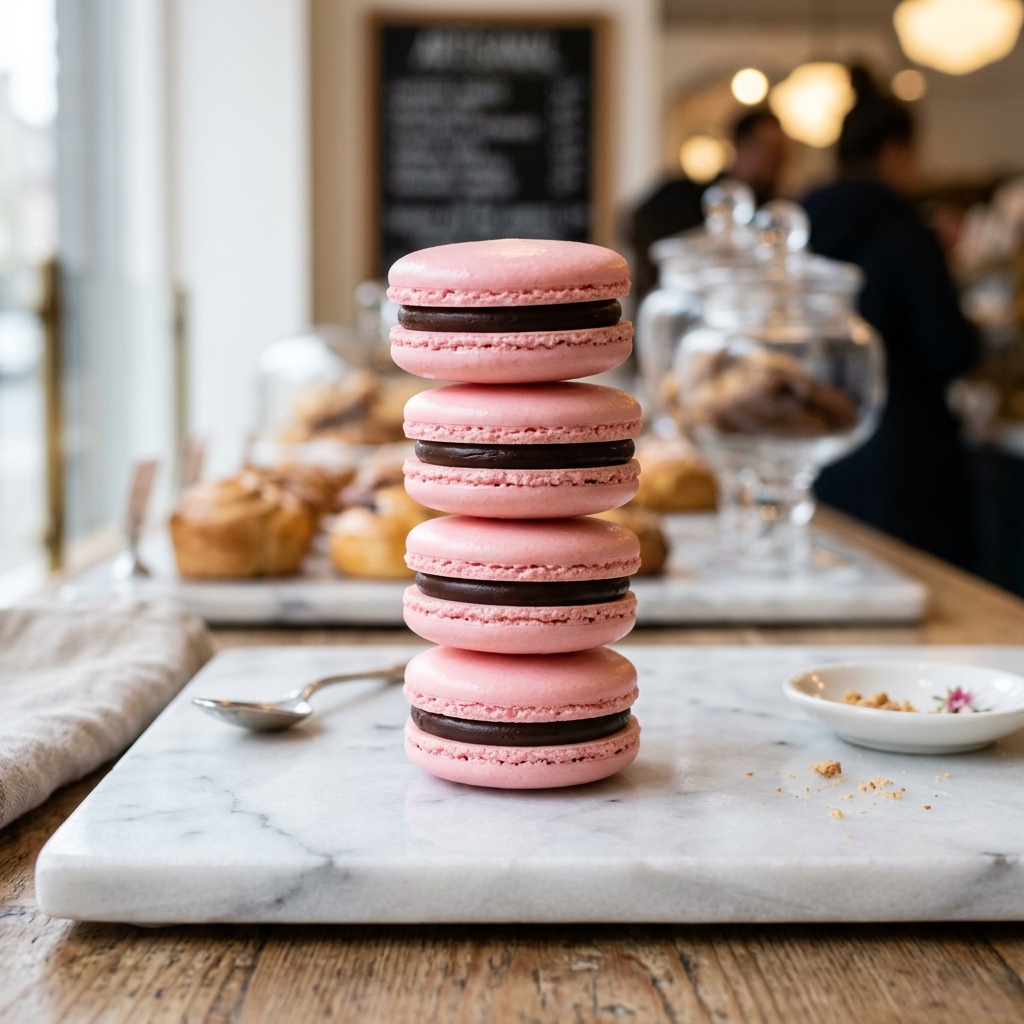
Foolproof French Macarons
A reliable, step-by-step guide to making French macarons. We cover how to fold the batter, dry the shells, and bake them perfectly to get those classic ruffled feet and smooth tops.
Ingredients
Make sure it is super-fine almond flour. Coarse flour will leave you with bumpy shells.
The starch in powdered sugar helps absorb extra moisture and keeps the shells stable.
This is roughly the whites from 2.5 large eggs.
Whips into the egg whites to create a strong, glossy meringue.
A tiny pinch helps stabilize the egg whites so they don't collapse.
Do not use liquid food coloring; it adds too much water to the batter.
Step-by-Step Instructions
Pulse and Sift the Dry Ingredients
Put the 100g of almond flour and 100g of powdered sugar into a food processor. Pulse 5 times to blend, then sift the mixture through a fine strainer into a bowl. Throw away any larger almond pieces that won't pass through.
Sifting gets rid of larger almond bits, which is the secret to getting perfectly smooth, glossy macaron tops.
Whip the Egg Whites to Stiff Peaks
In a clean, completely grease-free metal bowl, whip the 75g of egg whites and 1g of cream of tartar on low speed until frothy. Slowly add the 75g of granulated sugar, one tablespoon at a time, while raising the speed to medium-high. Whip until the meringue is glossy and holds stiff peaks when you lift the beaters.
Cream of tartar stabilizes the egg whites, helping you whip up a strong meringue that won't collapse in the oven.
Fold the Batter (Macaronage)
Add the dry ingredients to your whipped meringue in three separate additions, folding gently with a rubber spatula. Once mixed, use the spatula to gently smear the batter against the side of the bowl to deflate some of the air. Stop folding when the batter flows off your spatula in a thick, shiny ribbon like warm lava, forming a figure-8 that takes 15 seconds to fade back into the batter.
This is the most critical step. Fold until the batter flows off your spatula like warm lava. If you under-mix, the shells will be hollow; if you over-mix, they will spread too flat.
Pipe and Tap the Tray
Put the batter into a piping bag with a medium round tip. Pipe 1.5-inch circles onto a silicone baking mat. Tap the baking sheet flat against your counter 6 times, then use a toothpick to pop any tiny bubbles on the surface.
Tapping the tray on the counter pops any trapped air bubbles that would otherwise crack your shells in the oven.
Let the Shells Dry
Let the piped cookies sit on the counter for 30 to 60 minutes. They are ready when you can gently touch the top of a shell and your finger stays completely dry and non-sticky.
Drying the tops creates a shell that forces steam to escape from the bottom, creating those beautiful ruffled feet.
Bake One Sheet at a Time
Preheat your oven to 300°F (149°C). Bake the macarons on the middle rack for 14-16 minutes. Let them cool completely on the baking mat before peeling them off gently.
Let the macarons cool completely before peeling them off the mat, or the bottoms will stick and tear.
Nutritional Profile
Macros listed below scale dynamically based on the serving size selected in the recipe card.
Kitchen Timer
Need to scale or convert sizes?
This recipe links with our specialized calculators. Use them to calibrate oven dials, adjust brine salinity percentages, or scale baking pans.
Try the Oven Temperature ConverterTechnique Notes
- Grease-free tools: Before you start, wipe down your mixing bowl and beaters with a bit of white vinegar. Any trace of oil or egg yolk will keep your egg whites from whipping.
- Aged egg whites: Separate your egg whites 24 hours in advance, cover the bowl with plastic wrap with a few holes poked in it, and leave it in the fridge. This evaporates a bit of water, giving you a stronger meringue.
- Use gel coloring only. Liquid food coloring adds too much water, which ruins the delicate batter texture.